Category: Blog

  • How to deal with disputes about residential tenancies?

    How to deal with disputes about residential tenancies?

    The following information was correct at the time of writing; however, it’s an ever-evolving industry, so we do recommend doing your own research.

    For many tenants and landlords, it is unclear what steps to take when facing tenancy issues. If you are uncertain about your legal entitlements, this article is for you. We are here to help by listing the most common situations that often lead to disputes in the Tenancy Tribunal and providing guidance on the steps you can take to address them.

    Tenancy Services

    Tenancy Services are an agency of the government. They offer information and support to tenants, landlords, and their agents, and make sure they understand and follow Residential Tenancy Act 1986.

    Tenancy Tribunal

    The Tenancy Tribunal is a court that holds hearings to make decisions on problems between landlords and tenants who have not been able to reach agreement in mediation.

    The Tenancy Tribunal and Tenancy Services deal with disputes about residential tenancies.

    Reasons to initiate a Tenancy Tribunal hearing

    Disputes can arise over a range of issues, such as rent, repairs and maintenance, bond refunds, and eviction notices. Common disputes between tenants and landlords include:

    • Rent arrears: Disputes can arise if a tenant falls behind on their rent payments.
    • Damage to property: If a tenant has caused damage to the property beyond normal wear and tear, the landlord may apply to the Tenancy Tribunal to seek compensation for the cost of repairs.
    • Rent increases: If a landlord wants to increase the rent, they must follow specific rules and regulations. If a tenant believes that their landlord has not followed the rules, they may apply to the Tenancy Tribunal to dispute the rent increase.
    • Repairs and maintenance: Disputes can arise over the responsibility for repairs and maintenance of the property. Landlords are generally responsible for maintaining the property in a reasonable state of repair, while tenants are responsible for keeping the property clean and tidy.
    • Health and safety issues: If there are issues with the property that pose a health or safety risk to the tenant, they may apply to the Tenancy Tribunal to force the landlord to fix the issues.
    • Bond disputes: If there is a disagreement between the landlord and tenant regarding the return of a rental bond, either party may apply to the Tenancy Tribunal to resolve the dispute.
    • Breach of tenancy agreement: If either the tenant or landlord breaches the terms of the tenancy agreement, the other party may apply to the Tenancy Tribunal to seek resolution or compensation.

    These are just a few examples of the reasons why a tenant or landlord might choose to initiate a Tenancy Tribunal hearing in New Zealand.

    Steps to take in resolving disputes

    If there are conflicts arise between a tenant and landlord in New Zealand, Tenancy Services recommend the following steps to take.

    • Discuss the issue: The first step in resolving a dispute between a tenant and landlord is for the parties to discuss the issue and try to find a solution. It is very important to find out about your rights and responsibilities, and follow the processes set out in the RTA 1986, its Regulations, and other Amendments, and communicate with each other.
    • FastTrack Resolution: A fast way to formalise the agreement reached between tenants and landlords after a dispute is FastTrack Resolution, which is a service provided by Tenancy Services. If the landlord and tenant have a discussion and agree on what will happen, the landlord can let the tenant know that they are going to apply for FastTrack Resolution to formalise the agreement and then apply online.
    • Mediation: If the parties are unable to resolve the dispute through discussion, they can try to resolve the dispute through mediation. They must make an application to the Tenancy Tribunal.

    Tenancy Services will arrange mediation services, set up a mediation meeting and provide a mediator. This may be a phone conversation or a meeting in person. During mediation, a mediator helps everyone discuss the problem, identify the issues, and produce a workable solution. Mediators know a lot about tenancy issues, but they don’t decide anything for you.

    When an agreement has been reached, the mediator checks that each person fully understands what they are agreeing to. The agreement is usually written down as a mediated order which the mediator signs. Each person is given a copy of the mediated order.

    A mediated order is legally binding and will usually say what happens if it is broken. If either person doesn’t do what was agreed, then the mediated order can be enforced as if it was an order of the Tribunal.

    In some situations, mediation will not be an option and an application will go directly to the Tenancy Tribunal. For example:

    1. the tenant has assaulted or threatened to assault the landlord’s family or agent, other tenants or neighbours.
    2. where the tenant has been found to have abandoned the tenancy.
    3. where the tenant has substantially damaged the property or is threatening to do so.
    • Tenancy Tribunal: If mediation fails, the parties can apply to the Tenancy Tribunal for a resolution. The tenancy Tribunal appoints tenancy adjudicators, who can formalise what is agreed at mediation or can make a ruling on an issue that can’t be resolved an issue an order that is legally binding on the parties involved in the dispute.
    • District Court: If the parties are not satisfied with the decision of the Tenancy Tribunal, they can either apply for a rehearing or appeal to the District Court for a review. The District Court can make a decision on the dispute, which is binding on the parties.

    It’s important to note that there are specific laws and regulations that govern the relationship between tenants and landlords in New Zealand. These laws cover issues such as rent, bond, repairs and maintenance, and eviction. If a dispute arises between a tenant and landlord, it’s important to seek legal advice and follow the appropriate dispute resolution process.

    Also, if you are a landlord, watch this highly informative video about what you should not do as a landlord:

    Watch the video on YouTube


    More tips

    • Fill in the Tenancy Tribunal application form as precisely as possible. You can find it online on this page.
    • Do a Tenancy Tribunal check online. Read and analyze Tenancy Tribunal orders similar to your case. Head to the Tenancy Tribunal database to do this.
    • For Tenancy Tribunal mediation, hire a Property Manager. CGPM Property Managers offer expert Tenancy Tribunal mediation services.
    • If you’ve lost the case, don’t worry: apply for a Tenancy Tribunal rehearing instead. This is a hearing that you can apply for if you think the decision made was wrong legally. You have 5 working days after a decision is issued to apply for a rehearing.
    • Find more tips about winning a Tenancy Tribunal hearing in this article.
  • Can I kick someone out of my house if they don’t pay rent? The legal scenario

    Can I kick someone out of my house if they don’t pay rent? The legal scenario

    The following information was correct at the time of writing; however, it’s an ever-evolving industry so we do recommend doing your own research.

    Are you at your wit’s end with your tenants’ late rental payments? Or maybe you want to know how to evict someone who doesn’t pay rent? You’re not the only one. Landlords often do not know how to approach this situation, whether for fear of conflict or not being sure about their legal rights.

    If you want to find out how to handle tenants who pay rent late, read on. We will cover all possible scenarios and recommend the legal way to deal with them. We will also answer landlords’ most frequently asked questions. Keep reading to discover:

    • How to deal with late paying tenants;
    • Your and your tenants’ rent rights and responsibilities;
    • How to get help for every possible rent-related scenario out there.

    Rental payment schedule

    Rental payment conditions

    Any rental payment conditions relating to property damages and wear and tear are mentioned in the tenancy agreement. Some common examples include:

    • Not allowing tenants to smoke in the house.
    • Limiting the number of people allowed to live in a house.
    • Forbidding parking cars in certain areas of a property.

    Reasons why tenants may refuse to pay rent

    Tenants are legally responsible for paying the rent. If they don’t, they incur a late rental payment fee. Yet, on occasion, they might refuse to do so for reasons such as:

    • They are waiting for the landlord to conduct promised repairs.
    • One of the multiple tenants is unable to pay for their part of the rent.
    • The tenants’ financial situation means they cannot afford it that month.

    In the two first scenarios, tenants will still have to pay rent. They are most likely to receive a late rental payment notice from their landlord. In the last scenario, it is up to the landlord whether they want to negotiate a solution with their tenant.

    Naturally, landlords will not be happy to hear that their tenants are refusing or are unable to meet their obligations. You may be feeling angry at the prospect of not getting paid, but you should act rationally. Try calming down and following our bulletproof plan for resolving the situation in the best manner possible.

    If you can’t calm down, you can even call the police – this was exactly what the landlord did in the video below! Watch how the non-paying tenant explained the situation:

    If tenant doesn’t pay rent: resolving the issue on your own

    So your tenants always pay rent late and you want to attempt to resolve the issue on your own. Here are your options:

    1. Exchanging emails, letters, or text messages

    Message the tenant by email, letter or SMS and tell them the solution that you propose.

    The advantage of this method is that, with written communication, you have a record of what was said and promised. This could be useful if things escalate to the Tenancy Tribunal after sending the relevant letter of demand for rental payment.

    The problem is that this method lacks urgency and is impersonal, while it also means that you’re not in control of how long it takes to receive a reply.

    2. Personal meeting

    If your tenants won’t pay rent, talking face-to-face is the most direct way to resolve the issue. It is quicker than sending a letter too.

    However, if you are not well prepared for the meeting and don’t know your rights and responsibilities in advance, there’s a chance it could lead nowhere, and you’ll have to follow up.

    To prepare for a tete-a-tete meeting with your tenant, read the self-resolution guide offered by Tenancy Services first.

    Reaching an agreement

    If your communication efforts are successful and you do manage to reach an agreement with your tenant, here’s what to do:

    • Write down what you’ve agreed, then sign and date it.
    • Arrange a follow-up meeting to check how things are going.
    • Apply for FastTrack Resolution if you want to formalize your agreement.

    Tenant can’t pay rent: going to the Tenancy Tribunal

    If after your efforts, your tenant refuses to pay rent still and you haven’t reached an agreement, these are your options:

    • If your tenant owes less than 21 days rent, you can issue a 14-day notice to remedy, giving the tenant two weeks to fix the problem.
    • If your tenant doesn’t remedy overdue rent or if they owe 21 days of rent or more, you can apply to the Tenancy Tribunal to either organize mediation or a court hearing to terminate the tenancy.

    If you have written a letter to tenant to pay rent on time but they won’t cooperate and you need advice, you can always call Tenancy Services.

    Notice to remedy

    A notice to remedy is a notice given by a landlord or tenant when they believe the other party has breached the tenancy agreement.

    In the case of rent arrears, it is essentially a demand letter for rental payment. It gives the tenant 14 days to fix the breach.

    For a notice to pay rent or quit template, head here.

    When to apply to the Tenancy Tribunal

    It is time to apply to the Tenancy Tribunal when you have exhausted your other options to resolve disputes with your tenants. A landlord could apply to the Tribunal, for example, in the following situations:

    • When a tenant does not pay rent for more than 21 days;
    • When a tenant needs to pay for damages caused to the property;
    • When there is disagreement about repaying the bond.

    Where to apply to the Tenancy Tribunal

    Landlords can apply to the Tenancy Tribunal online by filling in an eviction notice for failure to pay rent form. The application process is simple and does not take longer than ten minutes, but you will need to have readily at hand and be prepared to submit all necessary documentation.

    You can also make an application on paper to send in your failure to pay rent form. The application fee is $20.44 (including GST).

    Evicting a tenant for multiple cases of overdue rent

    Applying to the Tenancy Tribunal to terminate a periodic tenancy

    Recent amendments to the Residential Tenancies Act (RTA) mean that landlords can now apply to the Tenancy Tribunal to terminate a periodic tenancy in certain situations. Before applying to the Tribunal, a landlord will have issued the tenant with 3 written notices:

    1. If, within a 90-day period, rent that was due has remained unpaid for at least five working days, the landlord may issue a first notice.
    2. A second notice is served if rent falls due again and has not been paid within 5 working days of the second due date.
    3. A third notice can be served in the same way as a second notice.

    After all notices have been served and, within 28 days after the third notice was given to tenants, landlords can file an application to the Tenancy Tribunal.

    Example

    Below we explain how landlords are to send their pay rent or quit notice in a real example scenario. Note that to estimate the following, we are using an assumed rent payment date of Tuesday March 1st and that in our example tenants are paying rent on the 1st of each month.

    • Date when the rent is due: Tuesday March 1st:

    Landlords will be expecting payment from their tenants on the date the rent is due. If this day passes and, for the first time, their tenants haven’t paid rent, landlords will have to start considering sending a gentle pay rent or vacate notice.

    • Date of the 1st notice: Tuesday March 8th:

    Five working days after the rent due date, landlords can issue the first notice to tenant to pay rent, along with a separate 14-day notice to remedy.

    • Date of the 2nd notice: Friday April 8th:

    Following the second occasion of rent remaining unpaid for five working days after the rent due date, landlords can issue a second notice from landlord to tenant for failure to pay rent.

    • Date of the 3rd notice: Monday May 9th:

    Similarly to the first and second notices, the third notice to pay rent or vacate form is sent on the third occasion of unpaid rent five working days after the rent due day.

    • Dates when the landlord can apply to the Tenancy Tribunal: Tuesday May 10th – Thursday June 16th:

    Once three notices of overdue rent have been issued within a 90-day period, the landlord can apply for termination. Landlords have to do this within 28 working days from serving the third notice to their tenant.

    How to avoid late rental payments in future?

    If you want to avoid late rental payments by your tenants, it is recommended to:

    • Always check their credit to ensure they have a good record of rental payments prior to renting to them.
    • Make your expectations clear when it comes to rental payments when you’re signing the tenancy agreement.
    • Keep a good record of your tenancy-related documents so you always know when rent is due.
    • Call your tenants as soon as a rental payment has been missed.
    • Use a mediator to communicate with problematic tenants to show them you are taking the situation seriously.

    Overdue rent: FAQ

    If you are a landlord and your tenant doesn’t pay rent, don’t despair. Landlords can now take steps to legally terminate tenancies for rent arrears, and the process is simple. When you are renting your property, it is important to stay up-to-date with rental laws and be aware of what your rights and responsibilities are.

    Before you apply to the Tenancy Tribunal, you will need to issue your tenants with the appropriate notices for rent arrears. You will need to have patience, as the whole process from first notice to a Tenancy Tribunal application takes a while.

    If you have questions about late rental payments or anything tenancy-related, do not hesitate to contact CGPM. As Auckland’s leading property managers, CGPM’s team is qualified to provide you with professional, expert advice for your property management needs.

    Below we answer landlords’ most common questions.

    1. By law, when is the last day to pay rent?

    If you do not pay rent within five working days of its due date, you will be sent a 14-day notice to remedy, giving you two weeks to pay the overdue rent.

    2. How to remind a tenant to pay rent?

    To politely remind a tenant to pay rent:

    • Contact them to ensure they know what day the rent is due and how much is owed.
    • Remind them in writing how they can pay rent, by telling them which payment methods are accepted for example.
    • Encourage them to contact you directly if they are facing difficulties paying the rent.

    3. Can I postpone the rental payment until the next month if my tenant can’t pay rent this month?

    It is up to a landlord’s discretion whether they will be flexible enough to allow postponing rental payment until the next month. If a landlord does accept to postpone rental payment, they should make a written agreement with their tenants about this so that there is a record.

    4. What to do if tenant doesn’t pay rent?

    If a tenant doesn’t pay rent, landlords can issue them with notices and then apply to the Tenancy Tribunal for termination of the tenancy.

    5. What to do if the tenant didn’t pay rent and left?

    Just like a landlord would have to send a tenant a pay rent after eviction notice, they have to resort to legal avenues if a tenant leaves a property without paying rent. Having rental payment insurance comes in handy in this scenario.

    6. If someone doesn’t pay rent, can you kick them out?

    After serving the tenant with the relevant notices and applying to the Tenancy Tribunal, landlords can eventually kick out tenants who refuse to pay rent.

  • Where does bond money go? All you need to know before renting out your property

    Where does bond money go? All you need to know before renting out your property

    The following information was correct at the time of writing; however, it’s an ever-evolving industry so we do recommend doing your own research.

    Landlords have many worries, and a common concern is bond money. Where does it go? How can you get it in case your property is damaged? We are here to provide all the help with rental bond information that you may need. We will explain where bond money goes and how to get the maximum of it back. Read on to learn:

    • what Tenancy Services say about rental bonds;
    • how to pay bond;
    • what to do to ensure you are getting bond money back in full.

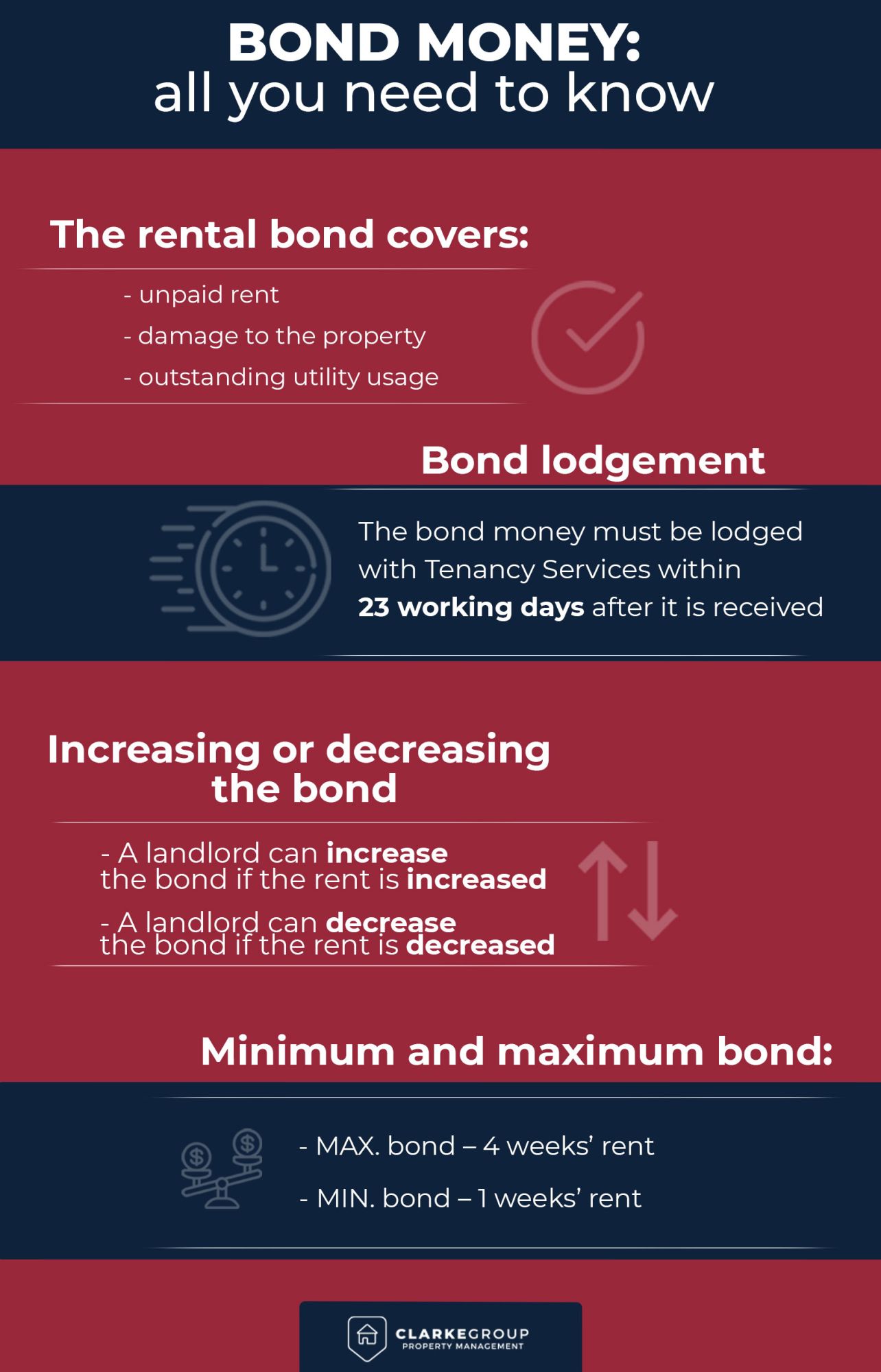
    Bond money infographic

    Bond money definition

    To define bond money, one could say a rental bond is a deposit that tenants pay a landlord when they move into a property. The bond is held by Tenancy Services and refunded after a tenancy has ended.

    For better undrestanding, watch this nice video of the two cute houses explaining the gist of renting!

    Rental bond NZ: What can it cover?

    The rental bond can cover situations such as the following:

    • Unpaid rent: If a tenant owes rent to the landlord, the landlord will keep the rental bond money.
    • Damage to the property: If a tenant has damaged furniture or another part of the property, the landlord will use rental bond money for repairs. Bond money returned to the tenant will be what is left over.
    • Outstanding utility usage: If it is established that a tenant hasn’t paid for utilities, e.g. electricity or Internet bills, upon the end of the tenancy, the rental bond will be used by the landlord to cover these expenses.

    Minimum and maximum bond

    The maximum rental bond payment amount a landlord can ask for is 4 weeks’ rent, while the minimum is 1.

    Increasing or decreasing the bond: When does it happen?

    A landlord can increase or decrease the bond only in one of two situations:

    • If the rent is increased. A landlord may ask the tenant to pay additional bond, in accordance with the increase. However, bond payments can only be increased once in a 12-month period and landlords must provide tenants with one month’s written notice.
    • If the rent is decreased. If the rent of a property has decreased, the tenant can apply for a refund of the extra bond that has been paid.

    Asking a new tenant to pay a bond: Is it compulsory?

    Even though most landlords ask for a bond, it is not compulsory.

    Advantages of bond lodgement

    Not lodging a bond is unlawful and can get landlords in serious trouble. Landlords will find that lodging the bond guarantees that their money is kept safe for the duration of tenancy and that it gives them a sense of security that they will have money to cover property-related expenses.

    Bond lodgement NZ

    Lodgement of bond means that the bond paid is transferred to Tenancy Services until the end of the tenancy.

    When should the bond be lodged?

    The bond payment date, i.e., when it must be lodged with Tenancy Services, is within 23 working days after it is received.

    Bond lodgement form NZ

    For a free bond lodgement form template, head to this website.

    Bond lodgement

    Signing bond lodgement forms

    Both the landlord and tenant(s) need to sign the bond lodgement form.

    Keeping document records as a landlord

    Landlords should keep the bond lodgement form, as well as all documents related to a tenancy, for at least 12 months after the tenancy ends. For tax purposes, landlords will need bond records for 7 years after the tax year to which they relate. Keeping these documents can be useful for landlords for:

    • Clearing up any issues related to the tenancy.
    • Being prepared for a Tenancy Tribunal hearing, if necessary.
    • Providing requested documentation to the Ministry of Business, Innovation and Employment, under the Residential Tenancies Act.

    How do you pay a bond?

    The bond is paid by the tenant to the landlord or property manager before they move into a rental property. It can be lodged with Tenancy Services by either of these parties.

    Bond Payment NZ: Available payment forms

    You have several methods for paying a bond.

    • As a tenant, you can pay bond online if you are lodging a single bond for 6 tenants or less. You can use a credit card, which is useful for individuals who may need rent bond assistance.
    • Landlords and property managers can pay by:
    1. Direct debit: if they often lodge multiple bonds at a time. This option is preferred by those who don’t want to pay large bank fees.
    2. Direct credit: if they lodge a bond for more than 6 tenants. This is the fastest option to pay.

    You can pay rental bond online on the Tenancy Services website, using the bond lodgement tool.

    Bond lodgement form

    Rent bond refund NZ

    Rent bond refund is when bond money is returned at the end of a tenancy. Depending on the state of the property and any outstanding costs, tenants will either receive the full amount back, part of it or nothing.

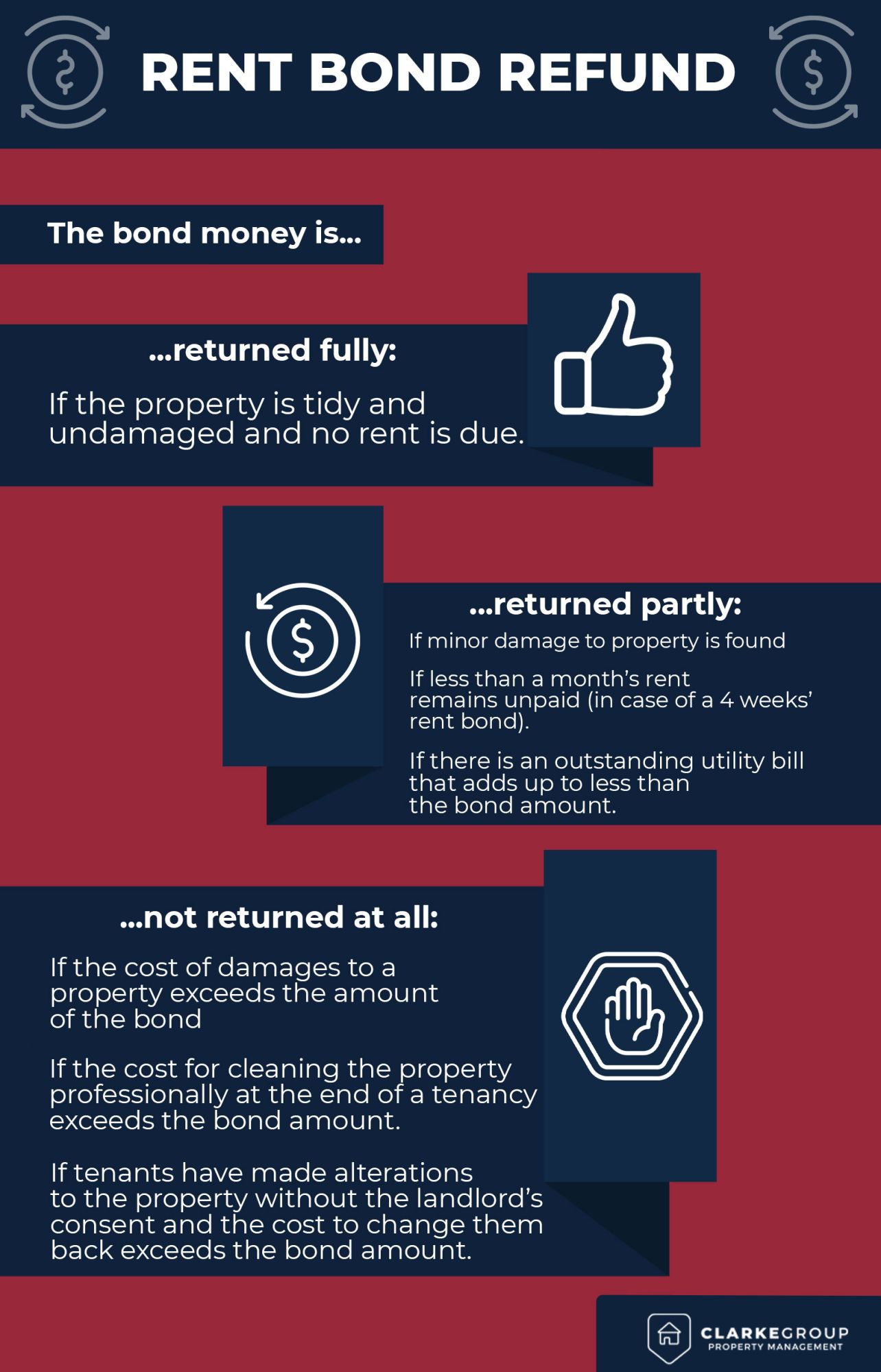
    Bond refund infographic

    Inspecting the property BEFORE signing the bond refund form

    Landlords and tenants should remember it is crucial to inspect the property, ideally together, before signing the form for return of bond money. This is to ensure that everything is in order and no damages have been caused for which deductions from bond money would have to be made.

    The bond money is:

    • returned fully:
    1. If the property is tidy and undamaged and no rent is due.
    • returned partly:
    1. If minor damage to property, like holes in the walls, is found.
    2. If less than a month’s rent remains unpaid, in case of a 4 weeks’ rent bond.
    3. If there is an outstanding utility bill that adds up to less than the bond amount.
    • not returned at all:
    1. If the cost of damages to a property exceeds the amount of the bond, e.g. if tenants have destroyed expensive appliances.
    2. If the cost for cleaning the property professionally at the end of a tenancy exceeds the bond amount. This is common when tenants ruin carpets, for example.
    3. If tenants have made alterations to the property without the landlord’s consent and the cost to change them back exceeds the bond amount.

    Disagreements about the refund amount

    There are sometimes situations when landlords and tenants can’t reach an agreement on the refund amount. In this case, they can either use a mediator or apply to the Tenancy Tribunal. This can be necessary in instances such as the following:

    • Disputes about whether damage predates a tenancy.
    • Disputes about the cost of repairs to cover damages.
    • Disputes about the tidiness level of the property.

    Bond refund forms

    Need a bond refund form? Visit this page.

    Rental bond refund

    Signing bond refund forms

    The bond refund form must be signed by the same people who signed the bond lodgement form, i.e., all named tenants and landlord. If it isn’t, it could cause delays in issuing the refund.

    What happens if a tenant or landlord can’t sign the bond refund form?

    On occasion, one of the people who signed the bond lodgement form is not available to sign the refund forms. This could be because:

    • They have already moved away.
    • They have passed away.
    • They are travelling.

    In these cases, landlords and tenants are advised to complete the form and send it to Tenancy Services anyway. Tenancy Services will attempt to find a solution.

    Keeping the bond refund document

    Landlords should hold on to documents for several years following a tenancy because:

    • They will need them for tax purposes.
    • They will need them in case they have to apply to the Tenancy Tribunal.

    Sending the bond refund form to Tenancy Services

    In order to get a refund, the bond refund form must be received and acknowledged by Tenancy Services, or it can’t be processed.

    Bond money NZ: When does it actually come back?

    It is currently taking up to 5 working days to refund a bond when a fully completed form is received.

    Unclaimed bond

    Unclaimed bond money becomes the property of the Crown 6 years post-tenancy.

    Bond lodgement FAQ

    You may be confused by bonds as a landlord, but you don’t have to be. Staying up-to-date with legislations and knowing when and how to send in your bond lodgement and bond refund forms is key for success.

    CGPM can streamline this process for you and offer help with bond money lodgement queries and any other questions you have. Don’t hesitate to contact CGPM’s expert real estate team for all your property-related needs.

    Below we’ve gathered landlords’ most common questions concerning bond lodgement:

    What is bond money used for?

    Bond money is used by landlords to cover expenses, such as unpaid rent or repairs due to damage to the property.

    Where does bond money come from?

    The tenant pays the bond to the landlord. The bond is then lodged with Tenancy Services.

    How much of a bond do you have to pay?

    Landlords normally ask for at least 1-2 weeks’ rent as bond. By law, they can ask for up to 4 weeks’ rent.

    When to pay rental bond?

    Tenants must give bond to landlords before they move in. This must then be lodged with Tenancy Services within 23 working days.

    How to pay bond?

    You can pay bond online, by direct debit or credit.

    Can you pay bond with a credit card?

    Yes, you can pay for bond with a credit card.

    How to pay a bond online?

    To pay bond online, go to this page.

    What happens to bond money? Where does my rental bond go?

    The bond money is held by Tenancy Services for safekeeping until the end of the tenancy.

    Do you get bond money back?

    If there’s no unpaid rent or other outstanding property-related costs, a tenant should get their bond money back fully.

    When do you get your bond money back?

    Once the bond refund form has been signed by both the landlord and tenant(s) and sent off, you should get the money within ten working days.

    How to get bond money back?

    In order to get bond money back, submit your bond refund form with the Tenancy Services.

    How long does it take to get bond money back?

    It normally takes up to 5 working days to refund a bond when a fully completed form is received.

  • What is fair market rent in my area? Financial issues explained

    What is fair market rent in my area? Financial issues explained

    The following information was correct at the time of writing; however, it’s an ever-evolving industry so we do recommend doing your own research.

    Are you having a hard time figuring out what to charge for your rental property? Deciding on the right amount of rent is often difficult for landlords. If you want to learn what is market rent and how to set the right price, you have come to the right place. We will tell you what factors to consider in order to ensure you are charging your tenants fairly. Read on to find out:

    • what factors influence market rent;
    • why you should resist the temptation of overcharging and charging below market rent;
    • how to calculate fair market rent.

    To get started, watch this helpful video:

    Watch the video on YouTube

    Market rent

    Market rent is the rental amount deemed reasonable for both a landlord and tenant when it comes to a tenancy. This amount must be similar to what is charged for the same type of properties in similar locations.

    Fair market rent

    A fair market rent definition is: a method of calculating the level that rent should be set at for a property, i.e., by estimating the 40th percentile of gross rents for standard quality units based on recent move-in data.

    Why landlords shouldn’t overcharge

    While as a landlord, it may be tempting to charge a little extra for renting your property, this is not a good idea because:

    • Overcharging can result in being investigated under the Tenant Fees Bill: Landlords can be asked to submit evidence to back up their fees and charges.
    • Properties with rental levels set well above fair market rent value can be very hard to let: Empty properties are the worst-case scenario for landlords as they produce no income, and costs can mount quickly. Overcharging is the most common reason a rental property will stand empty.
    • Overcharging means tenants are unlikely to stay in a property for long: If tenants think they are not being charged fairly, they are likely to look for a better deal and vacate a property as soon as their lease allows them to.

    Why landlords shouldn’t undercharge

    You may be surprised to learn that undercharging can actually be just as bad for you as landlord as overcharging. This is because:

    • Landlords can face below market rent tax consequences: If you are not making profit from renting your property, you will not be eligible for tax deductions related to it.
    • Undercharging tenants means losing money each month: Undercharging obviously decreases rental income and can result in landlords losing money on their property, as they will still have maintenance expenses.
    • Landlords who undercharge do not have a void period “safety net”: Landlords always face the risk of some void periods, i.e., periods with no tenants, so they should always ensure to maximise their income while they can.

    Key factors that influence market rent

    Current market rent is determined by various factors. These include, but are not limited to, the following:

    • Property type: Generally, properties are divided into several set categories. It is important to distinguish between different types of property when deciding what is fair market rent for a property, so as to charge appropriately:
    1. house/townhouse (a self-contained property usually with land)
    2. apartment (a property with self-contained and shared areas)
    3. boarding house room (in a property shared by 6 or more people)
    4. room (in a property shared by less than 6 people)
    5. bedsit (a one-roomed unit consisting of a combined bedroom and a sitting room with cooking facilities)
    • Location: Where a property is located is one of the most important factors affecting rental rates. Landlords renting properties that are close to amenities and transport hubs, in safe areas, will be able to charge more on “the market rent scale”.
    • Interest rate: As the real estate market heavily relies on mortgages, when interest rates rise, rental prices tend to fall. This will play a role in how to determine fair market rent and, thus, how much landlords can charge for their properties.
    • Inflation: Inflation will increase rental prices, since high mortgage rates mean less home purchasing power and, therefore, higher demand for rentals. Landlords wondering how to determine market rent must keep up with inflation statistics.
    • Supply and demand: To answer “what is the market rent for my property”, landlords have to consider supply and demand in their area in a particular period of time in order to decide what to charge. If a type of property is in short supply in an area, then rent will be higher than average.

    Fair market rent infographic

    Methods for defining the rent amount

    To answer “what is fair market rent in my area” and figure out the rental amount you should be charging, you can use one of the following methods:

    1. Analyzing rental bond data on your own

    You can use rental bond data to determine the ideal rent amount. This data provides information on the activity level in the housing rental market since 1993. Analyzing it will give you an idea of what private sector landlords’ bonds were, starting from January 1993.

    The advantage of this method is that it is free and contains a depth of information going a long way back. However, you could possibly make mistakes if you’re not careful and don’t analyse the latest available file, as there are some technical particularities with the database.

    2. Analyzing MBIE market rent data on your own

    Studying Ministry of Business, Innovation and Employment (MBIE) data can also help you determine rental price. MBIE publishes rental price data, which is used in regional housing reports and other publications.

    The advantage of this method is that it will give truly reliable data, as every landlord that receives a bond is required to lodge it with MBIE. However, the data does not distinguish between furnished and unfurnished properties, which is something that also affects rental prices.

    Female hands checking market rent data on a tablet

    3. Analyzing TradeMe market rent data on your own

    Using data from the Trade Me Property website can also help landlords figure out what they should be charging. Trade Me Property produces data on median rent statistics.

    The advantage of this method is that it is straightforward and reliable, coming from New Zealand’s biggest property website. However, one should remember that it only captures the weekly rent for new rentals on the market for individuals who choose publicly advertised rentals, not private ones.

    4. Using the online market rent calculation tool offered by Tenancy Services

    The online tool on the Tenancy Services website is another way to calculate what market rent should be for a certain property type. The tool acts as a fair market rent database that provides bond information for properties.

    The advantage of this method is that it automates rent calculations, so landlords only have to input some simple information instead of doing a complex market rent analysis. The website does specify, though, that this data should not be used alone to determine one’s rent – more factors need to be taken into consideration.

    When using the online tool, you will encounter the following terms:

    • Size: Number of bedrooms in a property.
    • Active bonds: The number of bonds received that had complete information about weekly rent, house type and other factors in that six-month time period.
    • Lower quartile: The weekly rent at 25% of all market rents.
    • Median rent: The middle value when all of the weekly rents are placed in order of value.
    • Upper quartile: The weekly rent at 75% of all market rents.

    Market rent calculation tool (Tenancy Services)

    5. Consulting a Property Manager

    If you do not want to analyse data on your own, as a landlord, you also have the option of consulting a Property Manager.

    Some advantages of this method are the following:

    • A Property Manager will expertly analyze past and current rental data from your area, eliminating guesswork.
    • When determining the right rental price, a Property Manager will be able to correctly factor in landlord costs and property expenses, like maintenance and repair costs.
    • A professional Property Manager can also help landlords lower their property-related expenses, due to their contractor connections, and, therefore, maximise their profits.
    • Working with a Property Manager means landlords don’t have to worry about consistent cash-flow, as rent will always be collected on time.
    • Hiring a Property Manager guarantees that landlords will stay up-to-date with legislations that could affect rental rates and, thus, will always be adjusting their prices and charging appropriately.
    • Shorter periods of vacancy. Not only will a property management company advertise to fill vacancies, but it will also maximize revenue.

    Market rent FAQ

    1. How to calculate market rent?

    For a fair market rent calculation, you will need information on your home’s value. Your rent is typically around 0.1% of its value.

    2. Where can I find a good fair market rent calculator online?

    To use a fair market rent calculator online, head here.

    3. Does fair market rent include utilities?

    Fair market rent includes essential utilities, like gas or electric, on top of rent but it does not include non-essential ones.

    4. Does charging less than fair market rent result in extra taxes?

    Renting below market rate means you are not eligible for tax breaks related to the rental use of your property. If you are not making a profit, you will not be able to deduct certain rental expenses.

    5. What does mid-market rent mean?

    Mid-market rent refers to homes for rent to households on low incomes. Mid-market properties are rented at lower-than-average prices.

    6. What is market rent vs contract rent?

    Market rent is also known as face rent, and it is the rental price that your unit would get right now if it were to be listed. On the other hand, contract rent is the amount actually paid right now by long-term tenants. This amount is normally lower than market rent rate.

    7. What is market rent vs effective rent?

    As explained in the market rent definition above, this is the rental amount payable as set out in the lease agreement or rental price listed by the landlord. Effective rent is this amount a landlord receives after paying all expenses for related to operating the property.

    Set the right price!

    Deciding what to charge for your rental property as a landlord is not an easy task. If you overcharge, you could lose the trust of your tenants, but if undercharge, you could be shooting yourself in the foot. When it comes to rental prices, you need to find that sweet spot that ensures you are making profit, but your tenants are also happy.

    There are several ways of calculating fair market rent by yourself online, but if you need expert help, click on the FREE RENTAL APPRAISAL link.

  • A guide to the Residential Tenancies Act: Who is protected?

    A guide to the Residential Tenancies Act: Who is protected?

    The following information was correct at the time of writing; however, it’s an ever-evolving industry so we do recommend doing your own research.

    While you may think of landlords as experienced know-it-alls when it comes to rental rights and responsibilities, few of them actually know their lawful obligations. It’s true that the information on the Residential Tenancies Act NZ can be a lot to digest at once, but we are here to make your life easier! We will enlist the most important parts of the Act for you. Specifically, this article will serve as a guide to the Residential Tenancies Act and tell you:

    • who the Act protects and who it doesn’t;
    • examples of real-life living arrangements covered by the Act;
    • how to ensure you stay up-to-date with changing regulations.

    What is the Residential Tenancies Act?

    The Residential Tenancies Act (otherwise referred to as ‘the Act’ or ‘RTA’) sets out the rights and responsibilities of landlords and tenants who rent residential properties in New Zealand.

    The main purpose of the Residential Tenancies Act

    The RTA is the law made to protect tenants and landlords in New Zealand. Its main purpose is to facilitate relations between landlords and their tenants by ensuring they comply with tenancy laws for the duration of the tenancy.

    Updates and major amendments

    The Act was issued in 1986 but it is often updated. The latest changes to Residential Tenancies Act regulations took place in stages, from August 2020 to February 2021.

    Residential Tenancies Act sections

    The Act consists of 5 parts, namely:

    1. Application of Act
    2. Boarding House Tenancies
    3. Tenancy Tribunal
    4. Administration
    5. Miscellaneous Provisions

    You can obtain the text in paper, but also read its online version on the NZ government’s official website.

    You can also find plenty of important information in this awesome video:

    Watch the video on YouTube

    Contracting into the Act: What it means

    If an individual is in a renting situation not covered by the Act, they can choose to contract into it. They will have to determine which part of the Act applies to their situation and have a written agreement created that clearly describes how everyone is to ‘contract in’ (e.g., what sections apply).

    Why landlords and tenants may want to contract into the Act

    If you are a landlord or tenant that is in a living situation not covered by the Act, you may want to consider contracting into it because:

    • If a dispute arises, the Act will ensure that the parties involved will be able to apply to the Tenancy Tribunal.
    • If you are a landlord, you will have peace of mind by knowing your tenants will be kept legally responsible for keeping the property clean and paying rent on time.
    • It will help you budget properly, as expenses and earnings, like rent increases/reductions and payments will be laid out clearly in advance.

    RTA infographic

    Who IS protected under the Residential Tenancies Act?

    Tenants

    A tenant is someone who rents a house from a landlord. This could be an adult renting an apartment, a family with children renting a house, or a couple renting a property to live in long-term.

    • The Act outlines NZ tenant rights and responsibilities.
    • The Act provides tenants with a system for helping resolve tenancy disputes.
    • When multiple people rent a house to live in together, they all become tenants together.

    Boarding houses

    A boarding house is a property for six or more tenants, where unrelated tenants each rent a room and share facilities, such as the kitchen and bathroom. Real-life examples of boarding houses include co-living spaces for young city workers, students or people who travel for work for long periods.

    • All tenants have their own tenancy agreement with the landlord to rent a single room.
    • There are no fixed-term tenancies in a boarding house, with agreements intended to last 28 days or more.
    • Boarding house landlords need to stay up-to-date with changes to tenancy law and comply with the healthy homes standards.
    • A boarding house landlord can make house rules, which must not breach the Residential Tenancies Act or any other law.

    Unlawful residential premises

    Unlawful residential premises are properties that cannot lawfully be lived in. In these properties, landlord obligations haven’t been met. Real-life examples of unlawful residential premises would include a garage, a property in a commercial premise such as office buildings, or a minor dwelling, such as a granny flat.

    • If a property has been deemed unsafe and unsanitary by the local authority, it is considered unlawful. Granny flats can be upheld under the RTA as long as the flat has a building code of compliance and meets the rules and requirements under the RTA.
    • Tenants can give their landlord two days’ notice to end a tenancy if the premises was unlawful at the start of the tenancy and/or is still unlawful.
    • The Tenancy Tribunal has full jurisdiction over unlawful residential premises cases.

    Who IS NOT protected under the Residential Tenancies Act?

    Some types of living arrangements aren’t covered by the Residential Tenancies Act. For example, the Act doesn’t cover flatmate situations, holiday homes and commercial tenancies, all of which we will talk about extensively below.

    Section 5 of the Residential Tenancies Act explains all the different situations that it doesn’t apply to.

    According to Residential Tenancies Act regulations, the following situations are not covered:

    Flatmates

    Flatmates are people who live in the property with the tenant but are not named on the tenancy agreement. In real life, this could include:

    • A homeowner who finds someone to live in their house with them and rents a room to them.
    • A few people who rent a house together but some of them don’t sign the tenancy agreement.

    The Act is clear in that it “doesn’t cover flatmates”. In the above situations, you would have to look into tenants’ rights and contract into the Act if you wanted to make your arrangement official.

    Boarders

    Boarders are “people who live with the owner of the house”. Real-life examples of this would include:

    • A homeowner hosting a student from abroad as part of an exchange.
    • A homeowner living with a new partner but not sharing the home on paper.

    Boarders have a relationship with a homeowner that ranges beyond monetary gain. For this reason, the Residential Tenancies Act landlord obligations don’t really apply here.

    Minors

    Minors are people under 18 years. Real-life examples include:

    • Young students.
    • A young, emancipated couple.

    The Act says, “Landlords may not be able to enforce the terms of the tenancy agreement against a minor”. This means you may have a hard time as a landlord if you need to enforce the tenancy agreement against a minor, as you will need to apply to the Tenancy Tribunal and have to brush up on your landlords’ rights.

    Landlord’s family members

    Situations, where the tenants are family members of the owner/landlord, aren’t regulated by the Act. The Act does not cover arrangements “where the premises, not being a boarding house, continue to be used, during the tenancy, principally as a place of residence by the landlord or the owner of the premises or by any member of the landlord’s or owner’s family”. Real-life examples of this would include:

    • A cousin living in the home freely.
    • A mother-in-law living with a couple in the spare room of their home.

    These are family relationships where rent would not be charged, so landlords’ responsibilities aren’t really an issue.

    Student accommodation

    This is accommodation officially used to house students. This includes:

    • University student dorms.
    • Student hostels.

    According to the Act, “In these situations, the accommodation provider must have house rules. The accommodation provider must make sure the student tenants are aware of and have access to copies of the house rules”. It is worth noting that these rules will differ from regular tenant rights NZ.

    Holiday homes

    Holiday homes are the premises that are let for the tenant’s holiday purposes. This could be:

    • A beach home visited by the owner in the summer months.
    • A country home that they exchange with friends in holiday swaps.

    The Act says that “If the homeowner wants to let their home to someone who wants it for a lengthy sabbatical or holiday, they could elect to ‘contract into’ the Residential Tenancies Act to avoid any doubt about whether the Act applies to their arrangement”.

    Hotels and motels

    These are the premises intended to provide temporary or transient accommodation. Real-life examples include:

    • A five-star hotel.
    • A bed and breakfast or Airbnb.

    The Act says hotels and motels are “accommodation that is ordinarily provided for periods of less than 28 days at a time”. This means that a stay in such a place would not fall under the Act rules, and one would not abide by regular tenants’ rights.

    Hospitals

    According to the Act, a hospital “or other institution for the care of sick, disabled, or aged persons” does not fall under its rules. Residential Act regulations, therefore, would not apply to:

    • Extended patient stays at hospitals.
    • Stays in clinics for multi-day treatments.

    If you are a long-term in-patient, there will be specific hospital rules that are expected to be followed.

    Rest homes

    These are the premises for people with significant difficulties coping with the activities of daily living. Some examples include:

    • Residents in institutions for disabilities who need special care.
    • Residents of homes for the elderly who need daily nurse attention.

    The “Act doesn’t cover rest homes”, which are regulated under separate legislation by the Ministry of Health.

    Commercial tenancies

    This is a type of tenancy “where the premises are commercial premises”. Examples of situations where the Act would not apply are:

    • Office buildings.
    • A shop with a back room.

    In these cases, there would be different avenues you would have to pursue to ensure that staying in the premises, rather than just working there, is legal.

    Know your rights!

    Knowing your tenant and landlord rights ensures that you always know what to do and what avenue to turn to when things get complicated. Being aware of your rights and responsibilities can make all the difference.

    While it may be time-consuming to read the Residential Tenancies Act and get to know it thoroughly, there is help at hand. We hope our summary has answered your questions about what the Residential Tenancies Act is, but if you want to know more about landlord or tenant responsibilities, contact CGPM. Our professional team of Property Managers are well known as the best in Auckland!

  • Fixed term vs periodic tenancy: Answers to landlords’ eternal questions

    Fixed term vs periodic tenancy: Answers to landlords’ eternal questions

    “`html

    The following information was correct at the time of writing; however, it’s an ever-evolving industry, so we do recommend doing your own research.

    Are you confused about the differences of periodic tenancy vs fixed term? You’re not the only one. The differences between a fixed term and a periodic tenancy are many, and they often cause questions both with landlords and tenants. In this article, we will explain how exactly these types of tenancies are different. Read on for answers to the most common questions related to the topic. Specifically, we will answer:

    • What are the tenancy trends in Auckland’s real-estate market?
    • What does periodic tenancy mean for landlords and tenants?
    • What does fixed term tenancy mean for landlords and tenants?
    • How can you ensure you choose the right type of tenancy for you?

    Whichever type of tenancy you choose, watch this helpful video to make sure that you act in compliance with the law:

    https://www.youtube.com/watch?v=0KMY-PNjz94

    Fixed vs periodic tenancy: statistics

    New Zealand’s and, in particular, Auckland’s real estate landscape has changed considerably over the past decade. Some statistics that are evidence of this, focusing on the proportion of periodic tenancy vs fixed term, are the following:

    • Even though fixed term vs periodic tenancy has been traditionally less popular with renters, this is changing. Ten years ago, fixed term tenancies accounted for only 35% of tenancies in Auckland, increasing to 51% five years ago.
    • Data shows that tenancy duration remains more or less steady, with the average tenancy duration in Auckland decreasing only slightly – something that could be explained by the fact that a high proportion of inner-city renters are students who are planning to move in the future based on job opportunities.
    • The central suburbs of Auckland have the longest average tenancies, while suburbs with average tenancies of over three years include Balmoral, Lynfield, St Johns, Paerata, Mangere Bridge, Devonport and Green Bay.

    Fixed term tenancy vs periodic tenancy: understanding the difference

    It is very important for both landlords and tenants to know about the differences between a periodic tenancy and a fixed-term tenancy for many reasons. These include:

    Periodic tenancy

    What is a periodic tenancy?

    A periodic tenancy definition would be a rental agreement with no end date. This means that it continues until written notice is given to end it by either the tenant or the landlord. In other words, a tenancy with no fixed duration is a periodic tenancy.

    Is a periodic tenancy good? Who is it suitable for?

    Periodic tenancies are great for people with regularly changing life circumstances, as they offer flexibility. If you don’t have a family and are thinking of relocating based on job prospects but want to keep a window of possibility open, a periodic tenancy is most likely suitable for you.

    Is there any special periodic tenancy law in New Zealand?

    The main official document regulating all periodic tenancy related issues is the Residential Tenancies Act.

    The laws that define periodic tenancy in New Zealand are often updated. You can stay up-to-date with periodic tenancy laws by visiting this website.

    What is a statutory periodic tenancy?

    A statutory periodic tenancy occurs when a fixed term tenancy ends and the tenant continues to stay at the property on a rolling, periodic basis without renewing their contract.

    What is a year-to-year periodic tenancy (yearly periodic tenancy)?

    Periodic tenancies must have a certain maximum duration, which is often a year. A yearly periodic tenancy is a tenancy that rolls from one year to the next.

    What is a periodic tenancy agreement?

    A periodic tenancy agreement is a written contract between a landlord and a tenant that sets out everything that a landlord and a tenant have agreed to about the tenancy.

    Where can I find a periodic tenancy agreement template free?

    For free periodic tenancy agreement templates, head to the Tenancy Services website.

    How long is the notice period for a periodic tenancy?

    Tenants must give landlords 28 days’ written notice in order to end a periodic tenancy. The length of time for giving notice to tenants as a landlord depends on their reasons for ending the tenancy.

    Where can I find a periodic tenancy notice template?

    You can find a free periodic tenancy termination notice template online on the Tenancy Services website.

    The link also contains a periodic tenancy notice by tenant form.

    When is terminating a periodic tenancy possible?

    Terminating a periodic tenancy is possible at any time after the tenancy agreement has been signed by both the tenant and the landlord.

    Where can I download a sample periodic tenancy rent increase notice?

    If you are a landlord who wants to increase periodic tenancy rent, you must inform your tenants in writing in advance. You can download a sample rent increase notice, as well as any periodic tenancy notice NZ, here.

    Where can I download a sample periodic tenancy eviction notice?

    If you find yourself in the unfortunate position of having to evict your tenants for some reason, you will have to inform them in writing as well.

    You can download a sample eviction notice for free.

    Fixed-term tenancy

    What is a fixed term tenancy?

    To define fixed term tenancy, one would say it is a rental agreement that lasts for a set amount of time, from a few months to a year or more.

    Is a fixed term tenancy good? Who is it suitable for?

    A fixed-term tenancy is great for individuals seeking long-term security. Fixed-term tenancies can be suitable for families who are set on a location for a long time due to work and education commitments. Many landlords also have a preference for fixed-term tenancies, as they provide a guaranteed long-term income.

    What is a fixed term tenancy notice?

    A fixed-term tenancy notice is a written notice given once the term ends in order for the tenancy to not become periodic automatically.

    How long is the fixed term tenancy notice period?

    Tenants need to give their landlord notice in writing at least 21 days before the term ends.

    Is ending fixed term tenancy early possible?

    You cannot end fixed-term tenancies early by simply handing in a notice. Fixed-term tenancies can only be changed if a landlord and all their tenants agree.

    Is getting out of a fixed term tenancy agreement legal?

    If the landlord and all tenants discuss and agree on early termination of a fixed-term tenancy, then this is legal. This agreement should be in writing and tenants should keep in mind that the landlord may charge a fee for ending the fixed term early.

    Where can I find a fixed term tenancy agreement template?

    To find a fixed term residential tenancy agreement template online, head here.

    Where can I download a sample fixed term tenancy rent increase notice?

    If you want to increase rent as a landlord, you will need to inform your tenants in advance by giving them a written notice. You can download a sample fixed term tenancy form notice online.

    Is a 5-year fixed term tenancy possible?

    As there is no fixed term tenancy NZ maximum length, a 5-year tenancy is possible.

    What is short fixed-term tenancy?

    Just like the fixed term tenancy definition, short fixed-term tenancy is also clear in its meaning. A short fixed-term tenancy is a tenancy the fixed-term of which is 90 days or less. Unlike a regular fixed-term tenancy, it does not automatically become periodic when the term ends.

    Boarding houses

    What is a boarding house?

    A boarding house is a residence intended to be occupied by at least six tenants who rent a single room and share the rest of the facilities, like the kitchen and bathroom. Boarding houses must comply with local council requirements, as well as healthy homes standards.

    What is a boarding house tenancy?

    A boarding house tenancy involves all tenants signing their individual tenancy agreement with the landlord. Boarding house tenancy agreements normally last 28 days or more and there are specific rules and regulations that must be followed by tenants and landlords.

    Service tenancy

    What is a service tenancy?

    A service tenancy is a tenancy where accommodation is provided for workers by their employer for the duration of their employment contract.

    Most of the standard rules that apply to regular tenancies apply to service tenancies as well, save for a few differences, like for instance that rent can be deducted from a tenant’s wages upon agreement.

    Make your choice!

    Different tenancies mean different rules, rights, and responsibilities for both landlords and tenants. This is why it is important to know what is a fixed term tenancy, and what is a periodic one, and what kind of tenancy suits your individual needs before signing a tenancy agreement.

    If you are a landlord looking for steady long-term income, you might benefit from a fixed-term tenancy. On the other hand, if you are looking to rent an apartment for only a couple of months before moving, you’re probably better off with a short term fixed tenancy agreement. Whichever you choose, you will need to be well-informed about the rules for terminating your contract, rent increases, evictions, and everything else that comes with renting so that you know exactly what you’re getting into.

    This is where CGPM comes in. For all your questions on different types of tenancies, rights and responsibilities as a landlord and tenant and more, contact CGPM. Our Auckland property management professionals will be able to guide you through the process of renting in Auckland.

    “`

  • The ultimate checklist for first time renters

    The ultimate checklist for first time renters

    The following information was correct at the time of writing; however, it’s an ever-evolving industry so we do recommend doing your own research.

    Are you finding yourself overwhelmed by the advice for first time renters out there? It’s true that renting a home for the first time may cause many questions – not only for tenants but also for landlords. We are here to answer all your questions with the ultimate first time renter checklist!

    Keep reading to learn:

    • what your rights and responsibilities are as a tenant or landlord;
    • what to keep in mind when moving into or renting a property for the first time;
    • the best tips for first time landlords and tenants.

    Landlord’s responsibilities

    Being a landlord for the first time means you will have to get informed about your rights and obligations. Landlords who are renting out property for the first time will need to be aware of their responsibilities under the Residential Tenancies Act 1986. Landlords are legally required to:

    • Ensure their property meets building, health, and safety standards.
    • Hand over the property to the tenant in decent condition. They must add carrying out all repairs and maintenance to their new landlord checklist well before a tenant moves in.
    • Allow tenants to peacefully enjoy the property without interruptions.
    • Inform tenants in advance if they intend to sell the property.
    • Be represented by an agent if they spend more than 21 consecutive days outside of New Zealand.
    • Declare income earned from renting the property.
    • Allow tenants’ requests to make minor changes to their rental property.

    Tenant’s responsibilities

    As a first time home renter, you will have to be aware of your responsibilities prior to renting a house. Your first time renters’ guide should include your responsibilities, which are:

    • Paying rent on time.
    • Keeping the property in good condition.
    • Immediately informing the landlord about any damage or repairs needed.
    • Paying for electricity, gas and internet.
    • Leaving the property clean, tidy, and rubbish-free, as well as returning all keys to the landlord.
    • Getting the landlord’s written consent in order to make minor alterations to the property.

    Mutual responsibilities

    It is the responsibility of both landlords and tenants to ensure the tenancy agreement is in writing and they have records of it. Landlords and tenants should always be keeping their contact details up-to-date, and neither party is allowed to change the locks of the property without the other’s permission.

    Landlord’s checklist

    Landlord’s checklist

    To be a successful first time landlord, you must tick off the following items off your checklist prior to putting your house on the market:

    • Carry out necessary maintenance and repairs.
    • Ensure your property is lawful for residential use, complying with building health and safety regulations. The healthy homes standards cover heating, insulation, ventilation, moisture ingress and drainage, and draught stopping.
    • Get all required statements. Landlords must provide statements for all tenants that they comply with the healthy homes standards, as well as an insulation and insurance statement.
    • Add checking that smoke alarms are correctly installed and working properly to your first time landlord checklist.
    • Advertise the property, as you won’t be able to accept bids without an advert displaying the rental amount.
    • Collect the contacts you’ll need for repairs, the local council or real estate agents that can solve your questions. This is one of the most useful new landlord tips that will save you lots of time!
    • Screen your tenants to ensure they are trustworthy and will take care of the property.
    • Record the condition of the property during the property inspection by taking photos as a last step of your first time landlord guide.

    Tenant’s checklist

    Tenant’s checklist

    If it’s your first time renting, there is a checklist for you, too! Before you take the big step of moving out of your family’s home, you will need to consider a few things carefully. Use the points below as your first time renting guide:

    • Tenancy duration: You should be aware of the differences between periodic and fixed term tenancies. Periodic tenancies have no end date, lasting until either the landlord or tenant decides to end them. Fixed term tenancies last until a specific date mentioned in a tenancy agreement. Think carefully about how long you want to commit to a specific property for.
    • Rental price: Choose a property you can comfortably pay for and consider applying for financial help if you are struggling to cover your rent.
    • Property location: Decide what type of area you would like to live in and find out what the future planned developments there are.
    • Collect necessary documentation: This includes your ID and references, among other statements.
    • Check that the property is safe: It is important to guarantee that it has working smoke alarms and meets all healthy homes standards. People renting a house out for the first time often forget to do this.
    • Get statements from landlord: Ensure that your landlord can provide you with all necessary statements, including one regarding the property’s insulation and information about the property’s insurance policy.
    • Finally, to complete your renting a house for the first time checklist, discuss house rules with the landlord: For example, are there any rules about smoking, pets or specifics about rubbish disposal and recycling?

    Mutual checklist

    At the end of the day, tenants and landlords must cooperate in order to achieve a smooth tenancy on both ends. Their mutual responsibilities include the following:

    • Reading and having a thorough understanding of the tenancy agreement before signing it.
    • Agreeing on the inventory of items provided with the property together and taking photos of the condition of the house on the move-in day.
    • Agreeing on the bond amount, which is normally four weeks’ rent.
    • Taking meter readings together in order to avoid possible future disputes.
    • Ensuring their contact details are up-to-date, as well as exchanging emergency contact numbers.
    • Keeping detailed records of anything relating to the rental property. One of the best reminders/tips for new landlords is that they are required to save copies of documentation for twelve months after the end of a tenancy.

    FAQ

    We’ve gathered first time renters’ most common questions. You can read our expert answers to them below. Also, watch this amazing video:

    https://www.youtube.com/watch?v=rxTlCNc2VwY

    How to move out for the first time?

    The first thing you have to do before moving out of your family home is to get your finances in order. If you have a steady income or enough savings, you will be ready to start looking for a suitable place to live. At this point, you will probably have many first time renter questions, so make sure to do a lot of research before renting a house.

    How much does it cost to move out for the first time?

    There is no one right answer to how much it costs to move out for the first time. Ideally, you want to have a decent amount of savings before you take this big step.

    Saving three to four months’ living costs is a good starting point for those considering moving into their first rental home. Even if you have a steady income, you must be prepared for unexpected expenses associated with living on your own and taking care of a property. Depending on where you live, a three-month safety net could range anywhere from $3,000 to over $5,000.

    Other than rent, you will have to factor in paying for utilities, food, transport and recreation. When renting your first house, you will also likely find that you need to put aside an amount for unpredictable costs that may arise from being responsible for the daily maintenance of a property.

    What do I need to rent a house for the first time?

    After you have set the budget for renting your first house, you will need to consider its location. Go through your “new tenant checklist” and find out about the area’s access to transport, amenities, safety, future developments and consider whether it suits your lifestyle.

    When you find an advert for a property you are interested in, you will be able to fill out a rental application and you will be asked for some documentation, such as your ID and references.

    What to do first when moving into a new home?

    While your first instinct when you step into your rental home if you’re new to renting may be to celebrate, the first thing you should actually do is make sure that the utilities are set up and, if not, connect them.

    Do a quick walkthrough to ensure everything is as it was during the inventory check with your landlord. If you have a child or pet, your next step should be to ensure that the property is child- and/or pet-proof.

    What to bring to someone’s house for the first time?

    If it’s the first time you’re visiting someone’s home, it is a nice, customary gesture to bring a small gift. This will be especially meaningful to someone who is renting a house for the first time. Your gift does not have to be expensive and, ideally, it should be something that contributes to their new home. Some ideas of gifts that are always appreciated include:

    • tea towels
    • wine glasses
    • candles
    • vases
    • potted plants

    When do you pay first month rent?

    Normally, you pay each month’s rent in advance, at the beginning of that month. A landlord can ask for 1 or 2 weeks’ rent in advance depending on whether the tenant will pay rent weekly or fortnightly.

    What does first and last month’s rent mean?

    First month’s rent refers to paying rent for the first month of your tenancy in advance, a practice meant as a security measure. Similarly, last month’s rent refers to the payment of one month’s rent, intended to cover the end of the lease.

    Enjoy your first home!

    Renting for the first time can be stressful for both renters and landlords. There is a lot to know so as to ensure you make the best decisions.

    To adequately prepare for renting a home for the first time, whether you are a landlord or a tenant, you need to know what your rights and responsibilities are. To ensure a smooth tenancy, before moving into a new property, make sure you have downloaded our full-proof checklist to help you navigate the first time rental experience.

    If you have any questions or need some guidance during this process, contact CGPM. CGPM care for your needs and are guaranteed to find you the exact property you are looking for and provide you with all the help you need when renting out a house for the first time.


    “`

  • Selling a rental property with tenants on a lease: 3 scenarios to follow

    Selling a rental property with tenants on a lease: 3 scenarios to follow

    The following information was correct at the time of writing; however, it’s an ever-evolving industry so we do recommend doing your own research.

    Are you confused about the differences of periodic tenancy vs fixed term? You’re not the only one. The differences between a fixed term and a periodic tenancy are many, and they often cause questions both with landlords and tenants. In this article, we will explain how exactly these types of tenancies are different. Read on for answers to the most common questions related to the topic. Specifically, we will answer:

    • What are the tenancy trends in Auckland’s real-estate market?
    • What does periodic tenancy mean for landlords and tenants?
    • What does fixed term tenancy mean for landlords and tenants?
    • How can you ensure you choose the right type of tenancy for you?

    Whichever type of tenancy you choose, watch this helpful video to make sure that you act in compliance with the law:

    https://www.youtube.com/watch?v=0KMY-PNjz94

    Fixed vs periodic tenancy: statistics

    New Zealand’s and, in particular, Auckland’s real estate landscape has changed considerably over the past decade. Some statistics that are evidence of this, focusing on the proportion of periodic tenancy vs fixed term, are the following:

    • Even though fixed term vs periodic tenancy has been traditionally less popular with renters, this is changing. Ten years ago, fixed term tenancies accounted for only 35% of tenancies in Auckland, increasing to 51% five years ago.
    • Data shows that tenancy duration remains more or less steady, with the average tenancy duration in Auckland decreasing only slightly – something that could be explained by the fact that a high proportion of inner-city renters are students who are planning to move in the future based on job opportunities.
    • The central suburbs of Auckland have the longest average tenancies, while suburbs with average tenancies of over three years include Balmoral, Lynfield, St Johns, Paerata, Mangere Bridge, Devonport and Green Bay.

    Fixed term tenancy vs periodic tenancy: understanding the difference

    It is very important for both landlords and tenants to know about the differences between a periodic tenancy and a fixed-term tenancy for many reasons. These include:

    Periodic tenancy

    What is a periodic tenancy?

    A periodic tenancy definition would be a rental agreement with no end date. This means that it continues until written notice is given to end it by either the tenant or the landlord. In other words, a tenancy with no fixed duration is a periodic tenancy.

    Is a periodic tenancy good? Who is it suitable for?

    Periodic tenancies are great for people with regularly changing life circumstances, as they offer flexibility. If you don’t have a family and are thinking of relocating based on job prospects but want to keep a window of possibility open, a periodic tenancy is most likely suitable for you.

    Is there any special periodic tenancy law in New Zealand?

    The main official document regulating all periodic tenancy related issues is the Residential Tenancies Act.

    The laws that define periodic tenancy in New Zealand are often updated. You can stay up-to-date with periodic tenancy laws by visiting this website.

    What is a statutory periodic tenancy?

    A statutory periodic tenancy occurs when a fixed term tenancy ends and the tenant continues to stay at the property on a rolling, periodic basis without renewing their contract.

    What is a year-to-year periodic tenancy (yearly periodic tenancy)?

    Periodic tenancies must have a certain maximum duration, which is often a year. A yearly periodic tenancy is a tenancy that rolls from one year to the next.

    What is a periodic tenancy agreement?

    A periodic tenancy agreement is a written contract between a landlord and a tenant that sets out everything that a landlord and a tenant have agreed to about the tenancy.

    Where can I find a periodic tenancy agreement template free?

    For free periodic tenancy agreement templates, head to the Tenancy Services website.

    How long is the notice period for a periodic tenancy?

    Tenants must give landlords 28 days’ written notice in order to end a periodic tenancy. The length of time for giving notice to tenants as a landlord depends on their reasons for ending the tenancy.

    Where can I find a periodic tenancy notice template?

    You can find a free periodic tenancy termination notice template online on the Tenancy Services website.

    The link also contains a periodic tenancy notice by tenant form.

    When is terminating a periodic tenancy possible?

    Terminating a periodic tenancy is possible at any time after the tenancy agreement has been signed by both the tenant and the landlord.

    Where can I download a sample periodic tenancy rent increase notice?

    If you are a landlord who wants to increase periodic tenancy rent, you must inform your tenants in writing in advance. You can download a sample rent increase notice, as well as any periodic tenancy notice NZ, here.

    Where can I download a sample periodic tenancy eviction notice?

    If you find yourself in the unfortunate position of having to evict your tenants for some reason, you will have to inform them in writing as well.

    You can download a sample eviction notice for free.

    Fixed-term tenancy

    What is a fixed term tenancy?

    To define fixed term tenancy, one would say it is a rental agreement that lasts for a set amount of time, from a few months to a year or more.

    Is a fixed term tenancy good? Who is it suitable for?

    A fixed-term tenancy is great for individuals seeking long-term security. Fixed-term tenancies can be suitable for families who are set on a location for a long time due to work and education commitments. Many landlords also have a preference for fixed-term tenancies, as they provide a guaranteed long-term income.

    What is a fixed term tenancy notice?

    A fixed-term tenancy notice is a written notice given once the term ends in order for the tenancy to not become periodic automatically.

    How long is the fixed term tenancy notice period?

    Tenants need to give their landlord notice in writing at least 21 days before the term ends.

    Is ending fixed term tenancy early possible?

    You cannot end fixed-term tenancies early by simply handing in a notice. Fixed-term tenancies can only be changed if a landlord and all their tenants agree.

    Is getting out of a fixed term tenancy agreement legal?

    If the landlord and all tenants discuss and agree on early termination of a fixed-term tenancy, then this is legal. This agreement should be in writing and tenants should keep in mind that the landlord may charge a fee for ending the fixed term early.

    Where can I find a fixed term tenancy agreement template?

    To find a fixed term residential tenancy agreement template online, head here.

    Where can I download a sample fixed term tenancy rent increase notice?

    If you want to increase rent as a landlord, you will need to inform your tenants in advance by giving them a written notice. You can download a sample fixed term tenancy form notice online.

    Is a 5-year fixed term tenancy possible?

    As there is no fixed term tenancy NZ maximum length, a 5-year tenancy is possible.

    What is short fixed-term tenancy?

    Just like the fixed term tenancy definition, short fixed-term tenancy is also clear in its meaning. A short fixed-term tenancy is a tenancy the fixed-term of which is 90 days or less. Unlike a regular fixed-term tenancy, it does not automatically become periodic when the term ends.

    Boarding houses

    What is a boarding house?

    A boarding house is a residence intended to be occupied by at least six tenants who rent a single room and share the rest of the facilities, like the kitchen and bathroom. Boarding houses must comply with local council requirements, as well as healthy homes standards.

    What is a boarding house tenancy?

    A boarding house tenancy involves all tenants signing their individual tenancy agreement with the landlord. Boarding house tenancy agreements normally last 28 days or more and there are specific rules and regulations that must be followed by tenants and landlords.

    Service tenancy

    What is a service tenancy?

    A service tenancy is a tenancy where accommodation is provided for workers by their employer for the duration of their employment contract.

    Most of the standard rules that apply to regular tenancies apply to service tenancies as well, save for a few differences, like for instance that rent can be deducted from a tenant’s wages upon agreement.

    Make your choice!

    Different tenancies mean different rules, rights, and responsibilities for both landlords and tenants. This is why it is important to know what is a fixed term tenancy, and what is a periodic one, and what kind of tenancy suits your individual needs before signing a tenancy agreement.

    If you are a landlord looking for steady long-term income, you might benefit from a fixed-term tenancy. On the other hand, if you are looking to rent an apartment for only a couple of months before moving, you’re probably better off with a short term fixed tenancy agreement. Whichever you choose, you will need to be well-informed about the rules for terminating your contract, rent increases, evictions, and everything else that comes with renting so that you know exactly what you’re getting into.

    This is where CGPM comes in. For all your questions on different types of tenancies, rights and responsibilities as a landlord and tenant and more, contact CGPM. Our Auckland property management professionals will be able to guide you through the process of renting in Auckland.

    “`

  • One own home or numerous houses for rent? Auckland experts’ opinion

    One own home or numerous houses for rent? Auckland experts’ opinion

    “`html

    The following information was correct at the time of writing; however, it’s an ever-evolving industry so we do recommend doing your own research.

    Are you struggling to decide between buying and renting property? Getting flustered Googling “homes for rent Auckland”? Indeed, choosing between buying and renting property is often a challenging task. Each option has different types of advantages. And we are here to provide an expert opinion on whether you should buy or rent Auckland homes. In this article, you will learn:

    • the benefits of renting vs. owning property
    • the most important things to consider before renting or buying property
    • how you should go about finding the ideal NZ property to buy or Auckland flats for rent

    Rent or own infographic

    Statistics

    There are estimated to be over 1,787,900 households in NZ and a homeownership rate of 65.6%. House prices have been on the rise in recent years and, so, homeownership rates are mostly dropping in every region.

    This is particularly true of Auckland, which is seeing the largest decline in homeownership rates. According to statistics, homeownership in Auckland has dropped from 72.7% in 1991 to 59.4% in 2018.

    This means that a lot of people in the country are renting their accommodation. Based on the 2018 census, 31.9% of households, i.e. 1.4 million people across the country are living in rented homes.

    The number of people who rent homes in Auckland is 604,100, i.e. 34% of the city’s inhabitants.

    To rent or not to rent? That is the question!

    SPACE

    1. Organizing your personal space: Should you buy or rent a house in Auckland?

    Own property: You can easily change chattels and fixtures.

    In your own property, you will never have to deal with disputes about chattels and fixtures.

    Chattels are items of personal property that were never intended to be fixed to the house and can be removed without causing damage to the property.

    Fixtures, on the other hand, are things permanently attached to the house or to the land.

    Chattels and fixtures are a common source of argument between landlords and tenants and, as an owner, you will never have to deal with that!

    Rented property: No fixtures.

    If you have chosen an Auckland home for rent to live in, you cannot renovate, alter or add fixtures, e.g. in garden sheds, pools etc. These are the responsibility of the landlord, who is also responsible for any costs associated with their repair and maintenance – which is a plus, in this situation.

    To get a better understanding of the differences between chattels and fixtures, watch this informative video:

    https://www.youtube.com/watch?v=1Uvo_V-Pcsg

    2. Knowledge of the district: Which area offers the best homes for rent in Auckland?

    Own property: You get accustomed to your own district.

    Buying your own property means that you have a permanent address and allows you to truly get to know your neighbourhood. This is important for creating a sense of stability.

    Rented property: Every time you move, you start from scratch.

    Starting from scratch is not easy, and homes in Auckland for rent can be expensive. Some people are overwhelmed by the idea of starting over, while others feel excited by it. If you’re the latter kind of person, you are guaranteed to experience diversity in Auckland’s different districts. Auckland straddles two coasts and you can find everything there – from bustling city life to calm white-sand beaches and rugged nature to the west.

    3. Diversity: Are properties to rent in Auckland better for those who prefer diversity?

    Own property: Lack of diversity.

    Some would argue that when you always stay in the same place in a city, be it a house or an apartment, you could get bored. While it’s true that owning a house doesn’t allow for diversity, if you are the kind of person that thrives on stability, this could be the right choice for you.

    Rented property: You can change your environment as often as you like.

    Tired of your home interior? If you are renting, all you would have to do in that situation is wait for your lease to end, and then you would be free to move along to another more inspiring location.

    4. Moving: How convenient is it to switch between Auckland rental homes?

    Own property: Moving from district to district within Auckland is not easy.

    You cannot just pack up a house like a suitcase and move out quickly when you get tired of your house. It takes time to sell your property and buy another one or find tenants for your property and rent a home somewhere else.

    Rented property: You can easily move to another Auckland district, city or even country whenever you like.

    If you are simply a tenant that wants to leave their accommodation, you will find that it is rather easy. Sometimes understanding landlords will even allow you to move out before the lease ends if they have found a new tenant!

    5. Choice: Rent a home in Auckland that is exactly like you imagined.

    Own property: If you’ve inherited your property, you may have to live in a home you don’t actually like.

    If you inherit a property, it usually means you won’t get an opportunity to create your dream house. Inherited properties often need a lot of renovations in order to appeal to their new occupants!

    Rented property: You can choose the best variant among dozens of Auckland homes.

    Renting allows you to find a property that suits your taste perfectly. With so many housing options available in Auckland (Google “homes for rent Auckland” and see for yourself!), if you don’t like an apartment, you just move on to the next one… just like that!

    6. Renovation: Who is responsible for renovating an Auckland property for rent?

    Own property: Needs renovation once in every few years.

    Maintaining a house does not come cheap. If you’re the owner of a property, renovation is your financial responsibility.

    Rented property: Renovation is the landlord’s responsibility.

    While tenants sometimes have issues convincing landlords to get on with required maintenance and repair work, they at least do not have to incur the costs of property renovation – a big advantage for renting a place.

    7. Consumerism: Does living in Auckland houses for rent promote consumerism?

    Own property: You tend to buy tons of things to make your home cosy.

    This is often an unnecessary cost, and the results can be cluttered and chaotic.

    Rented property: Remembering that you will be moving out one day prevents you from overspending.

    When you rent a house, you are unlikely to buy tons of unnecessary things that will be hard to pack when moving elsewhere. This saves you money and space!

    PEOPLE AND ANIMALS

    8. Kids: Are homes for rent in Auckland New Zealand kid-friendly?

    Own property: No repercussions for damages caused by kids.

    Parents will know that children can often get defiant and destroy things. Accidents can happen with kids around in a house, but at least if it’s your own property, you don’t have to compensate anybody else for damages.

    Rented property: Many Auckland landlords disagree to have tenants with kids.

    Many landlords show preference to tenants without kids, for the reason that children can unwillingly cause damages to property. Yet, it is unlawful to discriminate against prospective tenants with children under the age of 18.

    9. Education: Living in Auckland homes for rent, can you guarantee a stable education for your kids?

    Own property: Your kids can go to the same kindergarten/school/university.

    Owning your home means your children will be able to attend the same school throughout their education, which is really important for their growth and stability.

    Rented property: Disruptions to your kids’ education can occur when a tenancy comes to an end.

    If your landlord ends your tenancy, you will have to look for a property in the same district so that your children can keep attending the same school, which can be a difficult task sometimes.

    10. Age matters: Do you want to be looking for cheap houses for rent in Auckland when you’re older?

    Own property: Elderly people get attached to their homes.

    It is comforting for people to grow old in a house that is their own and where they have spent many years of their lives and made many memories.

    Rented property: It’s difficult for an elderly person to adapt to new places.

    With age, it becomes significantly harder to pack up your belongings and move to new places, setting up a home from scratch. It can take a toll mentally and physically on elders.

    11. Guests and fellow residents: If you live in flats to rent in Auckland, can you have guests?

    Own property: You can invite anyone and for any period of time.

    Owning your own house means you don’t need to inform anyone about who you are having over and when. If you want to let relatives stay over for an extended period of time, that is only your own business!

    Rented property: You need landlord permission if you want to invite a guest.

    You can only invite guests over to stay, especially for a long period of time, with landlord permission according to the NZ Tenancy Services rules. Most landlords allow guests to stay over no more than 10-14 days in a six-month period.

    12. Human relations: Who do you have to interact with when living in Auckland city homes for rent?

    Own property: You communicate only with your family and friends.

    Living in your own property, you get to have control over who you communicate with and who you let in. This can be a nice luxury if you’re a private person.

    Rented property: Landlord-tenants’ relationships are often difficult.

    In a rented property, you will always have to deal with your landlord. If you get lucky, communication with them will be easy, but landlord-tenants’ relationships are notoriously difficult and you may have to prepare yourself for some inevitable conflicts.

    13. Pets: Do houses to rent in Auckland allow pets?

    Own property: No repercussions if pets damage something in your own property.

    If your pet causes damages to your property, you may have to replace an item or two, but it’s no big deal as you are only holding yourself liable and will not be having to compensate a landlord.

    Rented property: Many Auckland landlords disagree with tenants having pets.

    Since pets are known for scratching surfaces and flooring and causing damage to property, many landlords show preference for tenants without pets. Homeowners insurance does not always cover pet damage, so they are likely to avoid tenants with pets if they do not have the right coverage. When looking for a place online, make sure to add “pets allowed” to your “Auckland rent a house” search to facilitate the process.

    MONEY

    14. Bond vs down payment: Should you save for a down payment or pay the bond on a house for rent in Auckland?

    Own property: Making a down payment

    In New Zealand, you generally need a 20% deposit to get a mortgage. An Auckland homebuyer needs to scrape together $159800, while in Dunedin and Christchurch they would need about $90,000.

    Rented property: Making a bond payment

    To live in a rental home in Auckland New Zealand, the maximum bond you will be required to pay is an amount equal to 4 weeks’ rent. When the tenancy ends, tenants are refunded the amount after a property inspection.

    15. Payments: What is the average rent in Auckland New Zealand?

    Own property: No need to pay rent.

    While you may have to take out a loan to buy your property, you will never have to pay rent! Loan payments don’t increase and, in fact, they can even decrease in case of refinancing your mortgage, which involves your bank or lender paying off your old mortgage with a new one.

    Rented property: You need to pay rent.

    Unfortunately, rent is high around the country and is likely to increase. The average rent price in Auckland is around $600 a week. The national median weekly rent for a small house (1 to 2 bedrooms) was estimated at NZ$390 a week, and NZ$525 for 2 to 4 bedrooms.

    So, which is less expensive – paying rent or paying loan – and why? Well, that depends on your specific situation. Buying a home is an enormous investment, so it is vital that you do not rush into your decision.

    16. Taxes: Is it better to buy a house or to find a house to rent in Auckland?

    Own property: You need to pay property taxes.

    If you own a property, you will have to pay local property taxes. These are levied by local authorities and based on the rateable value of a property. The annual cost for an average family house is between NZ$1,000 and NZ$2,000.

    Rented property: You don’t need to pay property taxes.

    One of the greatest advantages of renting a house is that you do not have to deal with extra bills! You can rest easy knowing that property taxes are your landlord’s responsibility.

    Rent a home in Auckland!

    New Zealand, and specifically Auckland, is a great place to live, as it offers so much diversity and a fantastic quality of life. Depending on your circumstances and what you are looking for, you can either buy a house in the country or choose from one of the many houses for rent in Auckland New Zealand. We have explicitly outlined the benefits of renting and the benefits of buying so that you can weigh them up for yourself and make the right choice.

    If you are looking for our expert opinion… We recommend first trying renting properties and exploring different flats for rent in Auckland before committing to one single property or one single location where you’re going to buy. This will help you get a feel for what you want before you officially become a homeowner.

    Use CGPM to help you find the ideal property, no matter your situation. Our expert team has the knowledge to get you the best deal out there – whether you’re looking for an Auckland house for rent or to buy your dream home!

  • 15 best places to live in New Zealand: An honest review

    15 best places to live in New Zealand: An honest review

    The following information was correct at the time of writing; however, it’s an ever-evolving industry so we do recommend doing your own research.

    Deciding where the best place to live in New Zealand is remains difficult for many immigrants and locals. It is a country that offers abundant choices! Life in each city or town has its own benefits. Here, we promise to provide an honest review of NZ’s top cities and towns to live in. Specifically, we will talk about:

    • what you should consider when choosing a place to live in;
    • our top choices for the best places to live in New Zealand;
    • how to find the best place to rent in Auckland.

    New Zealand quotes

    While there aren’t any traditional sayings about life in New Zealand, some famous personalities have been quoted as saying the following about it:

    • “New Zealand <…> is a unique place because it is so far away from the rest of the world. There is a sense of isolation and also being protected.” (Elijah Wood, an American actor)
    • “I feel that New Zealand is my second home.” (Luke Evans, a Welsh actor)
    • “New Zealand is a place where you can get well.” (James Nesbitt, an Irish actor)

    New Zealand population statistics

    The largest cities in New Zealand are Auckland (1.6 million people), Wellington (215,000 people) and Christchurch (383,000 People).

    New Zealand has 10 cities with between 100,000 and 1.6 million people and 33 cities with between 10,000 and 100,000 people. The country is divided into 16 regions for local government purposes.

    New Zealand is mainly an urban country, with almost 90% of its population living in urban areas and cities. The country’s rural population was reported at 13.38% in 2019.

    Choosing the best city to live in New Zealand: The ultimate checklist

    Best City to Live in NZ (Infographic)

    When choosing the best area to live in New Zealand, these are the key factors that you should consider:

    1. City/town size

    Do you want to live in a large city or in a small town? There is no “best part of New Zealand to live”. In reality, each place has its own advantages:

    Advantages of living in a large city:

    • Better job opportunities.
    • Access to a mass transportation system.
    • Plenty of shopping, food, and entertainment options.

    Advantages of living in a small town:

    • Low traffic.
    • Lower cost of living.
    • Proximity to nature.

    2. Population size

    Do you want to live in a densely or sparsely populated place? Perhaps you are looking for some of the best small towns to live in New Zealand?

    Advantages of living in a densely populated place:

    • Better quality of roads and buildings.
    • Transport facilities are highly developed.
    • Most amenities and entertainment locations are within easy reach.

    Advantages of living in a sparsely populated place:

    • Less crime.
    • Natural beauty of landscape.
    • Access to fresh air.

    3. Rural/urban area

    Whether you prefer rural or urban areas plays a big role in how to decide where to live in New Zealand!

    Advantages of living in a rural area:

    • More privacy.
    • Larger homes.
    • Cost of living is cheaper.

    Advantages of living in an urban area:

    • Meeting more people.
    • Easy access to all amenities.
    • Saving money by using public transport.

    4. Climate

    The weather will probably play a role in your decision about the best city to stay in New Zealand! The country is located within the boundaries of two climate zones. The country’s North Island falls within the subtropical climate zone, and the South Island falls within the temperate climate zone.

    Perhaps the words “subtropical” and “temperate” lead to the popular false assumption that New Zealand is a warm country! In reality, the weather is often variable. The North Island can get extremely hot in the summer, while the alpine areas of the South Island can be as cold as -10°C in winter. Keep on reading to discover the city with best weather in New Zealand!

    5. Transport

    Transport is a serious factor to consider when choosing what the best city to live in New Zealand is.

    Advantages of living in/near an important transport hub:

    • Shorter travel distances.
    • Cheaper commuting.
    • Helping the environment by not using vehicles.

    Disadvantages of living in/near an important transport hub:

    • Noise pollution.
    • Traffic snags.
    • Congested sidewalks and roads.

    6. Local infrastructure

    Some of the most important infrastructural facilities that contribute to what the best place to live and work in New Zealand are:

    • Road and railway transport system.
    • Communication networks.
    • Electric systems.

    7. Work / career / business

    If you are settling down somewhere, then you will probably be interested in finding good career opportunities there. You probably want to look for the best city to work in New Zealand. Geography can influence career decisions in numerous ways. You will need to decide what the best places to stay in New Zealand are for your specific career path.

    8. Crime rate

    You will also want to find a safe area to live in and probably look for the best place to live in New Zealand for families. Some factors that constitute an area’s crime rate include:

    • Violent crime.
    • Vandalism.
    • Theft/burglary.

    9. Ecology

    Some ecological factors that you may also want to consider when choosing the best cities to live in New Zealand are:

    • Access to clean water.
    • Environmental diversity.
    • Low levels of pollution.

    10. Rental prices

    Deciding on what the best place in New Zealand is probably also depends quite a lot on each city’s rental prices! In New Zealand, the lowest to highest average rental price for a two-bedroom, unfurnished apartment ranges from NZ$1,500 per month in cheaper areas to NZ$2,000.

    Best places to live in New Zealand

    Auckland

    Are you wondering what the best places to stay in Auckland New Zealand are? Curious about life in the city? Read on!

    • City size: 531 square kilometres (km²).
    • Population size: 1,600,000.
    • Rural or urban: Urban.
    • Climate: Warm, coastal climate without any temperature extremes.
    • Transport: Public transport in Auckland consists of buses, trains, and ferry.
    • Local infrastructure: Excellent infrastructure with a lot of government funding to support development.
    • Work: Auckland is a great place to start and/or develop one’s career, with job availability in every sector imaginable.
    • Crime rate: The level of crime is low to moderate.
    • Ecology: While the quality of the air is relatively pure, there is some air pollution.
    • Rental prices: The average weekly rent for an Auckland home is approximately NZ$600.

    The Economist crowned Auckland with the honourable title “The most liveable city in the world”. Eager to know why? Watch this amazing video:

    https://www.youtube.com/watch?v=Eh75UUPm4bQ

    Christchurch

    Looking for the best place to stay in Christchurch New Zealand? Here are some facts about it!

    • City size: 1,426 km².
    • Population size: 381,500.
    • Rural or urban: Urban.
    • Climate: Sunny, dry and often windy.
    • Transport: Public transport in Christchurch consists of bus services and ferry.
    • Local infrastructure: Christchurch infrastructure is excellent, with extensive developments to ensure a thriving community.
    • Work: Christchurch is a prosperous place that offers many job opportunities.
    • Crime rate: Crime rates are moderate and decreasing in recent years.
    • Ecology: Christchurch is characterised by unique biodiversity, which the community works to protect.
    • Rental prices: The average rent for a three-bedroom property in Christchurch is approximately NZ$500 per week or more for the very best place to live in Christchurch NZ.

    Coromandel

    If you’re interested in the best places to stay in Coromandel New Zealand, keep reading!

    • City size: 40 kilometres wide at its broadest point.
    • Population size: Almost 2,000.
    • Rural or urban: Rural.
    • Climate: Warm and temperate, with significant amounts of rainfall.
    • Transport: Coromandel public transport options include buses and ferries.
    • Local infrastructure: Local infrastructure faces pressure and growing demands from the area’s tourism growth.
    • Work: Coromandel has a strong tourism industry, which offers a lot of opportunities for work.
    • Crime rate: While there is bound to be some petty crime in tourist-heavy spots like Coromandel, it enjoys a relatively low crime rate.
    • Ecology: With its ecological and wildlife sanctuaries, it is a highly environment-friendly place.
    • Rental prices: The average rent for houses in Coromandel is NZ$475 per week.

    Dunedin

    Did your search for the “best place to stay in Dunedin New Zealand” lead you here? You’re in the right place!

    • City size: 3,314 km².
    • Population size: 128,800.
    • Rural or urban: Urban.
    • Climate: Summer in Dunedin is warm, but rainy, while the winter is cool.
    • Transport: A bus network serves as affordable transportation in the city.
    • Local infrastructure: Infrastructure in Dunedin is good, with the government actively working to upgrade drinking water and wastewater infrastructure.
    • Work: Dunedin is a good choice for people seeking out a diverse range of employment opportunities.
    • Crime rate: The crime rate is rated as low to very low, making it a very safe place to live in.
    • Ecology: When it comes to ecology in Dunedin, there are some concerns that the government is addressing about pollution and rubbish dumped within the natural environment.
    • Rental prices: Rental prices can range from NZ$270 to NZ$515 depending on the area of the city.

    Hamilton

    Want to find the best place to live in Hamilton NZ? Learn everything you need to know about the area here.

    • City size: 110 km².
    • Population size: 176,500.
    • Rural or urban: Urban.
    • Climate: May to August is warm and humid. Winter is cold and can even be snowy.
    • Transport: Public transport in Hamilton consists of only buses.
    • Local infrastructure: There are active plans to invest in Hamilton’s infrastructure, focusing particularly on its transit system.
    • Work: The city offers plenty of work opportunities, with many youth jobs available.
    • Crime rate: Hamilton’s crime rates have been described as moderate to high.
    • Ecology: While Hamilton does suffer from some pollution, the government is trying to tackle the leading sources of emissions in the city.
    • Rental prices: The average weekly rent in Hamilton is between NZ$400 and NZ$500.

    Marlborough

    To learn all about the location and best places to stay in Marlborough New Zealand, read on!

    • City size: 12,484 km².
    • Population size: 49,200.
    • Rural or urban: Mostly rural.
    • Climate: Dry climate with frequent summer droughts.
    • Transport: Transport in Marlborough consists of bus and ferry.
    • Local infrastructure: Marlborough’s infrastructure development is a priority for the government in order to support the growth of local businesses.
    • Work: As one of the country’s major wine industry locations, there is work in this sector which offers excellent prospects.
    • Crime rate: Marlborough is a safe area, with police there having the highest total crime resolution rate for any area in New Zealand in the past.
    • Ecology: Marlborough offers a beautiful natural environment, and the city works to manage any stress pollution effectively.
    • Rental prices: The average rental price in Marlborough is NZ$430 per week.

    Nelson

    Are you curious about what the best places to stay in Nelson NZ are? We have all the answers for you!

    • City size: 422.2 km².
    • Population size: 52,900.
    • Rural or urban: Urban.
    • Climate: Summer in Nelson is mild and warm, and winter is cool.
    • Transport: Nelson offers air, bus, train and ferry transport options.
    • Local infrastructure: There is a good number of development projects currently taking place in the increasingly popular area.
    • Work: Nelson offers many work opportunities, not only in the corporate world but also in its thriving art scene.
    • Crime rate: The area is very safe with low levels of crime.
    • Ecology: Air quality in Nelson can be affected by pollution.
    • Rental prices: Apartments for rent in Nelson start at NZ$320 per week, and you will have to pay even more for the best place to stay in Nelson New Zealand.

    New Zealand map

    Wellington

    “What is the best place to stay in Wellington New Zealand” is a popular question online. Find out why here!

    • City size: 444 km².
    • Population size: 215,100.
    • Rural or urban: Urban.
    • Climate: The city is windy, particularly in winter. The warmer months are December to April.
    • Transport: Wellington has a well-developed public transport system consisting of electric and diesel buses, commuter trains, ferries, and a funicular.
    • Local infrastructure: Wellington boasts excellent infrastructure that is constantly upgraded.
    • Work: Wellington, as a big city and the capital of NZ, offers a great number of job opportunities.
    • Crime rate: Crime in Wellington is low to moderate but on the increase.
    • Ecology: While Wellington faces air pollution from cars, it is an environmentally conscious city.
    • Rental prices: The average rent for a three-bedroom property is NZ$640 per week or more for the best place to live in Wellington NZ.

    Blenheim

    Are you here to find out about the best places to stay in Blenheim NZ? You’re at the right place!

    • City size: 17.2 km².
    • Population size: 28,200.
    • Rural or urban: Rural.
    • Climate: Warm and temperate climate with rainfall.
    • Transport: Transport in Blenheim consists of bus networks and ferry.
    • Local infrastructure: There is progressive implementation of various housing and other infrastructure projects.
    • Work: While Blenheim does not provide as many job opportunities as a big city, it belongs to the wider area of Marlborough, which offers more work.
    • Crime rate: The levels of crime in the area are moderate.
    • Ecology: Blenheim has been reported to breach air pollution standards in recent years, so, ecologically, there is room for improvement.
    • Rental prices: An apartment for rent in Blenheim is priced at upwards of NZ$420.

    Queenstown

    Interested in the best place to stay in Queenstown New Zealand? Keep on reading!

    • City size: 8,705 km².
    • Population size: 16,000.
    • Rural or urban: Urban.
    • Climate: Summer is warm, while winter can be cold and even snowy.
    • Transport: Queenstown offers a wealth of transport options from public buses to track shuttles and water taxis.
    • Local infrastructure: Infrastructure in Queensland is top-notch.
    • Work: Queensland is a fantastic choice of place for jobseekers of all ages.
    • Crime rate: Crime is reported to be on the rise in Queenstown.
    • Ecology: Queenstown, as a city, is dedicated to combating plastic pollution and protecting the environment.
    • Rental prices: The average rental price in the area starts around NZ$350 and moving upwards for the best places to stay in Queenstown New Zealand.

    Rotorua

    Are you here to learn about Rotorua? Then keep on reading!

    • City size: 2,615 km².
    • Population size: 77,300.
    • Rural or urban: Mostly rural.
    • Climate: Mild, temperate climate.
    • Transport: A network of buses serves the area of Rotorua.
    • Local infrastructure: New Zealand’s government is committed to improving infrastructure in Rotorua, as it is one of the country’s most popular tourist destinations.
    • Work: There are plenty of opportunities in hotels and the hospitality industry within the city.
    • Crime rate: The level of crime is moderate to high compared to other places in New Zealand.
    • Ecology: There are many conservation initiatives in the area.
    • Rental prices: Prices for apartments for rent in Rotorua range from NZ$200 to NZ$420 per week.

    New Plymouth

    Looking to stay in New Plymouth? This paragraph’s for you!

    • City size: 2,206 km².
    • Population size: 80,679.
    • Rural or urban: Urban, with a vibe of rural spaciousness.
    • Climate: Warm and temperate with significant rainfall.
    • Transport: Buses are the main form of public transport around New Plymouth.
    • Local infrastructure: When it comes to land development and infrastructure, the area is currently being heavily invested in.
    • Work: Since New Plymouth is an area rich in natural resources and with a strong dairy sector, job opportunities abound.
    • Crime rate: The crime levels are moderate.
    • Ecology: The city is focused on fighting against the problems of plastic and pollution in the ocean.
    • Rental prices: Apartments for rent in New Plymouth go for NZ$235 or more.

    Napier

    Keep reading to learn all about the area of Napier!

    • City size: 105 km².
    • Population size: 65,000.
    • Rural or urban: Urban.
    • Climate: Warm and temperate with significant rainfall.
    • Transport: The city has modern and affordable forms of transport, among which buses and trains.
    • Local infrastructure: Plans to develop an inland port in the city are currently underway.
    • Work: Napier is a popular tourist city, where work opportunities abound.
    • Crime rate: Crime rates are moderate to high compared to other places in the country.
    • Ecology: Levels of air quality in Napier are monitored to ensure a level of protection for humans and the environment.
    • Rental prices: Properties for rent in Napier are priced around NZ$375.

    Tauranga

    Tauranga is another one of the best places to stay in North Island New Zealand.

    • City size: 168 km².
    • Population size: 151,300.
    • Rural or urban: Mostly urban.
    • Climate: Subtropical and humid.
    • Transport: Tauranga’s public transport system consists of trains and buses.
    • Local infrastructure: Recently the city has somewhat fallen behind on its infrastructure projects.
    • Work: The area is rapidly developing and primed to become one of the best places to stay in New Zealand North Island.
    • Crime rate: The crime rates are moderate to low.
    • Ecology: Protecting the environment is a top priority for the city.
    • Rental prices: A central city apartment goes for NZ$470 per week.

    Timaru

    Did your search for “best places to stay South Island New Zealand” lead you here? It shouldn’t come as a surprise!

    • City size: 33.98 km².
    • Population size: 28,700.
    • Rural or urban: Urban.
    • Climate: Warm and temperate, with rain even during dry months.
    • Transport: The transport system mainly consists of buses.
    • Local infrastructure: A lot of work is being done to improve landfills and roads, among other projects.
    • Work: Employment opportunities are not as easy to find as in bigger cities, but there is room for starting a business in this developing place.
    • Crime rate: Recorded crime in the area has been falling, a reason for which it is considered one of the best places to stay in South Island New Zealand.
    • Ecology: Timaru has faced some air quality issues in the past – a situation that is improving.
    • Rental prices: Prices for rental apartments start from NZ$210 per week.

    Auckland – the very best city in New Zealand!

    So where is the best place to live in New Zealand? The country has a lot to offer, no matter which city you choose. Yet, if you are struggling to decide on what the best town to live in New Zealand is… we recommend Auckland.

    Auckland is a modern and thriving first-world city. With constant public transportation upgrades. And home to 27 Regional Parks. It is an ideal destination offering a perfect balance between business opportunities and an outdoor lifestyle. CGPM specialises in renting out residential homes in this wonderful city. Call CGPM today to learn more!